ePOP Concept
Build electrification cases in hours with ePOP’s physics-based platform.

Build electrification cases in hours with ePOP’s physics-based platform.
Find the best fit through detailed models and real-time insights.
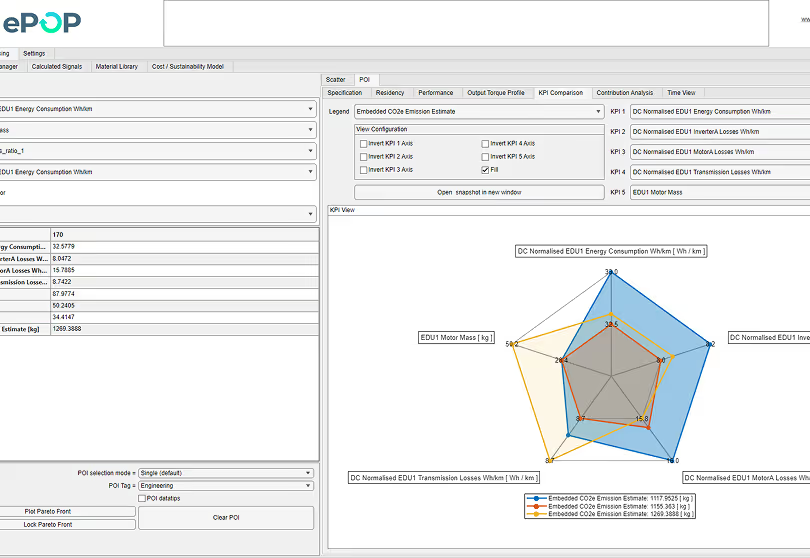
Turn complex simulations into clear visuals that align results with KPIs.


Unified value proposition

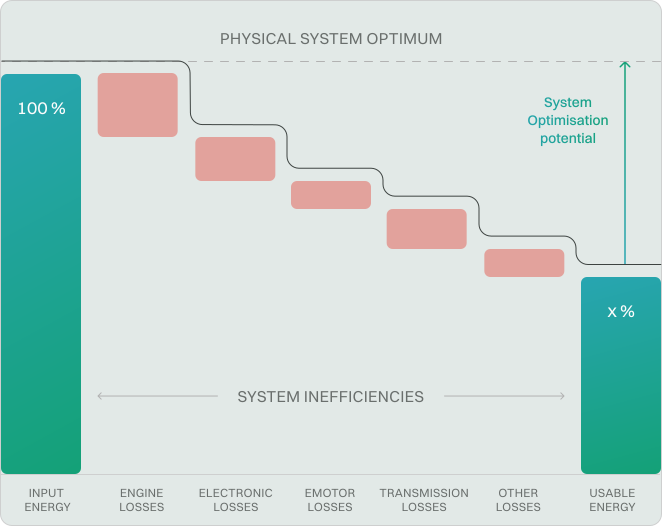
The concept phase

ePOP can display data from benchmark measurements side-by-side with the concepts being explored, allowing teams to easily compare performance metrics.

ePOP has frequently used system level architectures built-in to allow rapid investigations without the need to build models from scratch.

ePOP enables creating, importing, and viewing components in isolation — and combining many into system-level solutions for design exploration.

In its component models, ePOP allows higher fidelity to include detailed design choices (such as material selection) very early in the concepting phase.
Product suite
Load your operational duty cycle at millisecond resolution. Compare series hybrid, parallel hybrid, fully electric, ICE, and hydrogen fuel cell configurations simultaneously – across mass, volume, exportable power, range, and whole-life cost. ePOP Concept uses a zero-dimensional, first-principles model, correlating to within 10% of real-world hardware. Operational in under a day, no specialist simulation background required.
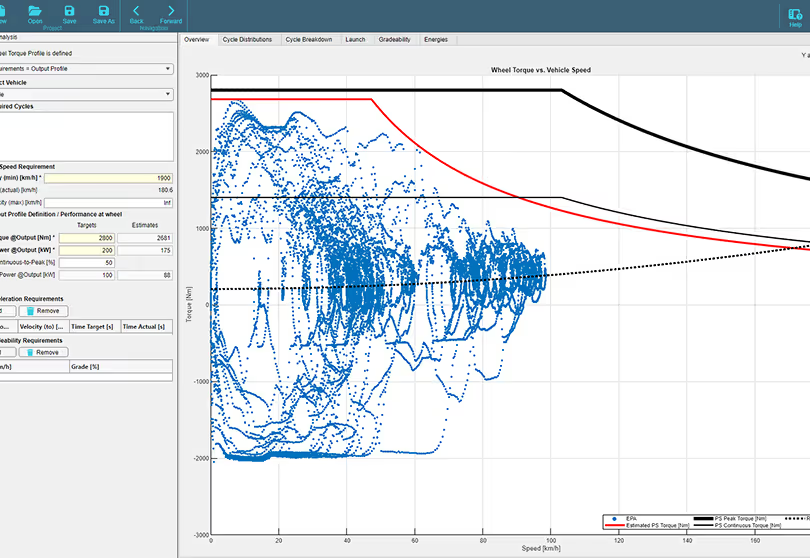
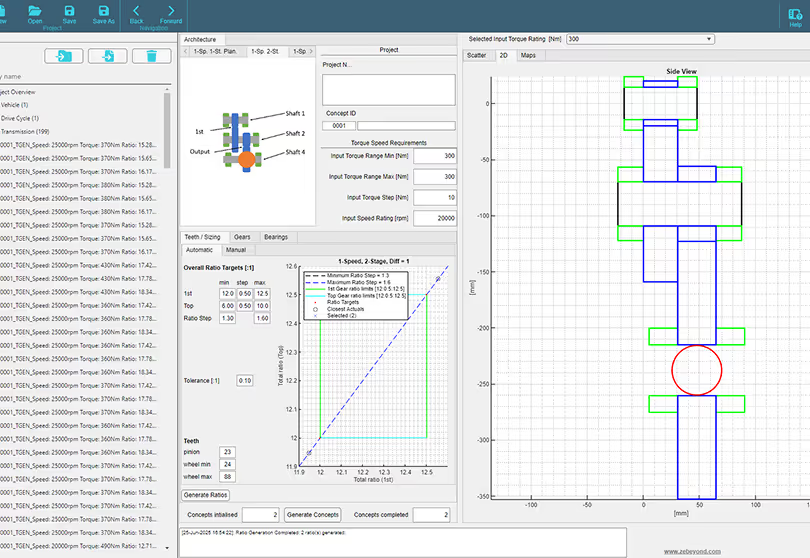
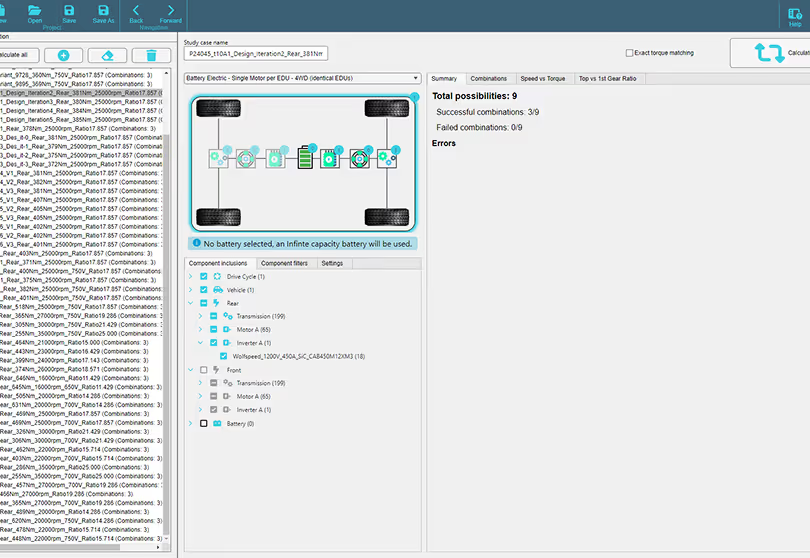

High-fidelity cycle modelling

Comprehensive component and architecture library

Architecture comparison & optimization

Insightful output and decision support
ePOP Pro extends to full speed-torque analysis, system-to-component loss iteration, and detailed efficiency maps with engine BSFC data. Cross-validated against benchmark CAE tools to within 1%. The appropriate tool for system specification level – not a simplified alternative to detailed design tools, but the right tool for the concept phase before those tools are applicable.

Component generation library
System-level loss & efficiency modelling

Trade-off exploration

Custom powertrain configuration
Verified loss maps and thermal data from more than 150 production vehicle platforms, including reverse-engineered motor models. When you are evaluating a motor type or architecture, you are working from validated performance data – not a manufacturer’s datasheet. Outputs are formatted for configuration review boards, procurement justification, and stakeholder reporting: results that can be challenged, which means they can also be defended.
Comprehensive xEV component library

Virtual competitive benchmarking

Contextualized insights & metrics

Data-centric collaboration & access control
Plans


Try adjusting the date, release, or category options.
FAQ
Still looking for answers? Explore the full FAQ to learn more about ePOP.
1. Rapid design-space exploration – Optimised to evaluate thousands of powertrain variants in a single study, so teams can converge on the most promising architectures quickly.
2. Financial and sustainability KPIs alongside engineering performance – Lets you assess technical performance together with cost and sustainability drivers, making trade-offs explicit earlier in the decision process.
3. Fast concept part generation (eMotor, inverter, transmission) – Generate concept components from target specifications to estimate system impact without needing detailed designs upfront, bringing system-level analysis earlier and reducing reliance on specialist tools for early screening.
4. Motor-CAD import – Seamlessly import Motor-CAD motor designs into ePOP to evaluate them in a full system context (drive cycle, architecture trade-offs, overall efficiency).
5. Focused powertrain evaluation and reporting – Not a general-purpose simulation environment; it’s purpose-built for powertrain analysis, with tailored reporting that simplifies comparing concepts and communicating results.
ePOP simulates the full powertrain and reports efficiency at both the system level and the component level (e.g., inverter, e-motor, transmission), so you can clearly see where losses occur. Once improvement opportunities are identified, you can use ePOP’s component library to swap in alternative designs and re-run the system simulation to quantify the impact. If an off-the-shelf alternative isn’t available, ePOP’s component concepting modules let you rapidly generate new variants and evaluate their efficiency benefit in the same workflow.
ePOP is a high level system-level simulation environment. Components are represented using a combination of scalar parameters (to capture limits and key characteristics) and performance maps (to capture behaviour across an operating range). For example, an e-motor might be defined by scalars such as base speed and maximum torque, alongside maps such as efficiency versus speed and torque. This reduced order approach is commonly utilised in the simulation domain and is designed to evaluate many powertrain concepts quickly and support trade-off studies, rather than modelling a single powertrain in high geometric/physics detail.
The term "AI" captures a wide range of solutions and technical approaches. In the simulation domain, optimisation algorithms (a type of AI) have been in use for decades, and ePOP is no different when addressing the challenges of discrete optimisation. Another type of AI is Neural Networks, which can specifically be deployed to some benefit if there are large amount of static real world measurements available, to replace static physics based simulation. As ePOP (and all other simulation software) lack large amount of measurement data, and usually perform optimisation including time domain analysis, Neural Networks provide little/no benefit and are therefore not necessary in ePOP. The challenge of correlation to real world measurements is usually addressed by ISO standards, which do exactly that: fit analytical/empirical models onto real world measurement data. ePOP relies on ISO standards for engineering accuracy. And finally, the use of LLM's (large language models) to support future engineering workflows is an exciting area of AI development. We are all aware of the limitations of LLM systems when it comes to providing physics based answers to engineering questions. ePOP aims to support the agentic ecosystem by providing an MCP that LLM systems can utilise to increase the reliability of such workflows. Direct integration of LLM based workflow assistants and MCP servers is on the product roadmap.
ePOP Concept correlates to real-world applications through the use of power-versus-time duty cycles defined at the powertrain output, from which sub-component sizing is derived using first-principles power and energy analysis. The tool has been exercised using load profiles obtained from existing production applications. When the resulting component sizes are compared against the corresponding real-world hardware, the predicted sizing is typically within 10%. To balance limited data availability with computational speed, ePOP Concept employs zero-dimensional, physics-based models that capture the dominant system behaviors relevant to early-phase architecture decisions.
For analysis requiring a higher degree of freedom and time-domain fidelity, ZeBeyond’s other toolset ePOP Pro extends this approach using one-dimensional dynamic simulation incorporating efficiency maps and engine BSFC maps. ePOP Pro has been correlated against real-world measurement data to within <1% and has additionally been cross-validated against established industry-standard simulation environments such as GT-Suite.